
Pathologically Genuine: What do you think?
Here is what ChatGPT thinks

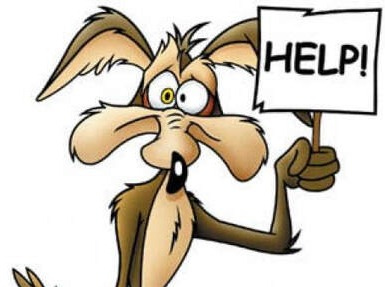
Note for For my subscribers that clicked a direct link from email. I want you to know that the first paragraph below will not make sense without the following information. The picture associated with this post on Substack is of Wyle E Coyote holding a help sign. Here is it for your viewing pleasure.
_________________
I actually am not calling for help. I just love Wyle E. Coyote. I know many people do. So, the picture was a trick intended to open the gates of your empathy causing you to click on this post. If you are reading this, then my trick must have worked.
I have a love-hate relationship with AI. I love its ability to answer question after question with ease and certainty drawing information from somewhere on the internet, particularly when its answers make me feel good. I hate it because it pretends to answer those questions with absolute clarity when the actual answers are tentative, nuanced and complex. AI is also programmed with the following business model: “flattery will get us everywhere including getting someone to sign up for a paid subscription”
I have reached a stage on my Pathologically Genuine writing journey where I am stuck on how to move my articles forward into a book. I will soon partner with a book coach to help me and will definitely not rely on AI. I am really excited to start that work.
Nonetheless, I decided to engage in a free consultation with ChatGPT to see what it thought about the “writing of Jim Coleman” and how that writing compared to another author who has a book contract with a major publisher on similar themes. It found distinct differences in our writing on the web which was encouraging.
It also came up with this “hook” and short description of the book that was actually helpful to me in trying to think through how my stories come together. It does not capture what I am thinking perfectly, but it passed my 70% rule making it useful to think about.
I am curious about comments from readers who are here because you fell for the Wyle E. Coyote empathy scam…or not
Here is what ChatGPT had to say:
One-Sentence Hook
A late-diagnosed renown autistic professor and former dean, provost and vp for research traces a lifetime of loneliness, masking, and meaning—showing how success can coexist with profound isolation, and how understanding arrives without erasing the cost.
Overview (1–2 pages in full proposal)
Pathologically Genuine is a narrative-driven memoir about living an entire life without a name for one’s differences—and what happens when that name finally arrives. Through vivid scenes and humor rather than clinical explanation, the book explores childhood sensory overwhelm, adolescent and adult loneliness, romantic rejection, teaching as both refuge and performance, and a long marriage that brings love without curing isolation. A late-life autism diagnosis reframes—not redeems—the past. The book resists tidy resolutions and instead offers readers the rare relief of recognition.
This is not a guide to autism. It is a story about how meaning is made when understanding comes late, and why authenticity—especially for autistic people—can be a superpower but carries real costs.
It also had this to say about themes in my writing on autism, teaching and higher education.
"Jim Coleman’s most-engaged essays resonate because they name uncomfortable truths—about autism, teaching, and institutions—without offering false comfort, while insisting that meaning, dignity, and authenticity still matter."
It also found themes in my writing that are reasonably accurate but I wouldn't have articulated. That is kind of cool.
"Across all categories, a shared throughline emerges:
➡️ What matters most is rarely what is measured.
➡️ Lived experience is a legitimate form of knowledge.
➡️ Complexity should be honored, not smoothed away.
➡️ Being fully human—in classrooms, institutions, and relationships—is extraordinarily important and inherently inefficient.
➡️ This refusal to simplify is precisely what draws sustained readership."
I hope ChatGPT is right on drawing readership :
Would you read something like Pathologically Genuine? Leave a comment or answer the poll.
As a songwriter I believe in short hooks:
"Pathologically Genuine is a narrative-driven memoir about living an entire life without a name for one’s differences—and what happens when that name finally arrives."
Should suffice.
Interesting! I'm curious to see where your own exploration aligns or differs from Chat's.