
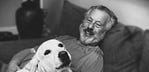

This piece was first drafted a day before what would have been my dad’s birthday. That seems apropos.
This is a revision of a previous draft that was driven by working with a craft coach for a bit. I won’t give out his name since I have no idea if it is any good. For me, it was exhilarating to write with what I thought was great guidance by the coach. I am happy to share his name if you would like.
For those that haven’t read anything else- Chapter one is a story about an anonymous letter filled with animus to my boss (the chancellor of U. Arkansas),which had twenty or so bullet points starting with “Shame on you.” One of the bullet implied that he had hired a crazy provost (me) who was under psychiatric evaluation. The chapter ends with the question of whether I am crazy. It is also a humorous chapter, even though it starts a darker theme of not fitting anywhere..
_________________________________________________
My dad was eighteen in 1950. One evening he was sitting at the desk in his bedroom in the brick two-story middle-class house on Beechwood Boulevard in the Squirrel Hill neighborhood of Pittsburgh. It was a smoky evening, haze from the steel mills hanging along the rooftops, as my grandfather drove into the garage just like he did hundreds of times before. My father looked out the window and watched the garage door close.
He never saw his father again.
The death certificate indicated my grandfather died of heart failure. Whether he died by suicide, by accident, or from natural causes remains a mystery. I don’t know who discovered the body. I also don’t know whether the death certificate was signed by a family friend who was a physician for life insurance reasons or by a coroner.
The tiny bit of information in family lore is that my grandmother held on to the belief that my grandfather died by natural causes. That makes sense to me based on what I remember about my grandmother. She didn’t seem like a woman who would have been capable of processing her husband committing suicide.
My father did not discuss this event in any detail with me or as a family, though we knew about his father’s death. I can only guess how the death affected my dad.
I suspect that my father believed his father committed suicide though he tried to stay noncommittal when I brought it up. I imagine there was no room for discussion in my father’s family as to the cause of death. The event, and the inability to process the pain that suicide incites in survivors, broke some part of my dad’s psyche. He carried an unusually heavy load of guilt, so unusual that it would break a truck scale. I also know that my dad felt an extraordinary responsibility to take care of people that he decided needed to be taken care of and he had a tremendous amount of anxiety about how people perceived him.
I imagined my dad’s father, Harry, as a colorful man who worked and succeeded in the bustling wholesale clothing district on Fifth Avenue. I know him mostly from a painted portrait. He was as handsome as a movie star, with fiery red hair, a ruggedly soft face, an athletic build, dressed to the nines in an expensive suit. I was told he had a boisterous personality and was the type of person that would buy everyone a drink at the bar. I knew he was well liked because when I was a pre-teen, my mother would take me down to Fifth Avenue to shop for clothes. It seemed that every store owner knew and loved my grandfather. I got a lot of free clothes. Most of them I probably didn’t wear because I only wanted to wear comfortable clothes like t-shirts and jeans.
I only learned the hazy details of my grandfather’s death recently from my older brother, Howard. Although my dad did not talk to me much about his father’s death, he talked six days a week to a psychiatrist for over forty years. He never told us about that either, at least he tried not to. I thought he had an awful lot of early morning meetings as a kid and that the early morning meetings on Saturday were strange, but dad did not invite questions about where he was going before he left or after he returned.
Despite all of this, my dad was anything but crazy. Quirky? Yes. Anxious? To a fault. Smart? Amazingly so. Compassionate? He could compete with Mother Teresa. The only really crazy thing he did was talking six days a week to a psychiatrist for most of his adult life, spending large sums of money I might have inherited.
Well, he also was a pretty crazy driver in the sense of not paying much attention. His mother used to say that the only time my dad looked people in the eye was when he was talking to them in the back seat while he was driving the car in the front seat. Sometimes my wife tells me I inherited that trait. I protest.
I ached for my father the more I learned about his past. But learning his history changed how I saw myself, too.
As an ecological and evolutionary biologist, I teach students about the complexity of animal behavior. Animal behavior is inherited through genes. But the way that genes influence behavior has many plastic components that are shaped by the environment.
Human behavior is malleable. Our genes allow many behavioral traits to be shaped by “nurture.” We inherit temperaments, anxieties, ways of loving, ways of responding to suffering, ways of understanding the world as we develop in a world with parental care, close-knit families, and social rules in our communities. For example, I doubt my genes caused me to scream at the TV during a Pittsburgh Steelers game, but my whole extended family and everyone who grew up in Pittsburgh with me does it. This malleable nature of human behavior makes discovering a phylogenetic behavioral tree an intriguing mystery.
Still, thinking about my phylogenetic tree might help me understand who I am and why I’ve been successful in my career despite feeling like a misfit. I’ve also wondered if something related to traits I inherited might explain that anonymous letter accusing me of being crazy and whether I was.
I started with my dad.
His original name was Marvin. His mother would take him out for walks in a stroller with one of her friends who had a boy of the same age. That boy’s name was Morton, though he acquired a nickname “Dizzy” after the famous baseball player Dizzy Dean.
My grandmother liked the name Morton better than Marvin, so she just started calling my dad Morton.
He acclimated to the stolen identity. He officially changed his name to Morton as an adult. He was affectionately known by most everybody as “Moe.”
Despite the name change, his family tree didn’t change. There is an irony in the sense that my dad took on a name that was not authentic, but he may have been in many ways the most authentic person I ever knew, other than keeping secrets about his past.
Perhaps I inherited his authenticity, but on steroids. I am genuine to a fault. I call it being pathologically genuine.
My parents knew each other for most of their lives. They lived within an area of maybe ten blocks in the Squirrel Hill neighborhood of Pittsburgh for most of their first forty years. As an adult, I’ve been rootless by contrast. I’ve never lived in the same place for more than seven years.
They married when they were twenty. They had my brother Howard when they were twenty-one and then had me when they were twenty-eight. I got married when I was thirty-eight.
My dad started off as a community organizer and civil rights activist working in settlement houses in the Hill District of Pittsburgh. He then moved into the Mayor of Pittsburgh’s office where he focused on addressing community development and poverty, and he also became an advisor to Henry Ford II on these issues. My brother and I are both socially progressive, too.
He started his PhD in political science at the University of Pittsburgh while he was working. He was smart. For example, he had to take statistics as part of his PhD program. He was not mathematically inclined and apparently paid almost no attention to the class until the final. My brother recalls him staying up all night reading the statistics book and acing the exam the next day.
He also declined offers from the PhD programs at Harvard and Columbia, the best programs in the field. As far as I understand it, he couldn’t overcome the guilt he would feel leaving his mother, so he chose Pitt. He always hoped that I would go to an Ivy League school. I eventually received my PhD from Yale, which I think helped fill a hole in his own life.
My dad became a professor of social work at Pitt and then the interim dean of social work. Then he moved to the University of Connecticut to become their dean of social work. He was a great dean and a beloved professor by students.
My dad cared about and believed in all of his students. I met many of his former students who told me how their lives changed because of meeting him. These included former gang members and prison inmates who developed successful careers. They all attributed their success to my dad’s belief in them and his mentorship. Over five hundred people attended his funeral, many of them former students.
It has been only recently, after he died, that I feel myself channeling my dad’s caring and belief in students when I am standing in front of a classroom and communicating with students outside of class. This feeling, along with notes I get from students, suggests to me that perhaps some sort of aptitude for mentoring and teaching was inherited.
My dad returned to Pittsburgh five years after moving to Connecticut to start The Institute of Politics at Pitt. It became a very successful organization bringing people together across the political spectrum to solve local and regional problems.
When he died, the Pittsburgh Post-Gazette wrote their own obituary, which honored him as “The Connective Tissue of Pittsburgh.” For most people outside of our family, that was a wonderful thing. But it was more challenging for us in the family which I think tempered that trait in me.
For example, my favorite place for breakfast was Ritter’s Diner on Liberty Avenue in Pittsburgh. The diner had booths lining the walls. Each booth was equipped with a 1950s coin-operated jukebox with modern selections. The diner only took cash and still does to this day. Each booth had a little rack with all the essentials—ketchup, jelly, napkins, salt and pepper. My dad’s mother was not a good cook. My dad turned to ketchup as a dietary necessity. I still make sure that we always have ketchup in the fridge and an extra bottle in the pantry.
The waitresses at Ritter’s had worked there for years and enjoyed my dad’s warmth and curiosity about people. I’d be sitting at a table with my favorite western omelet and home fries, while my dad had a 15-minute conversation with our waitress, asking her at least twenty questions. He beamed with appreciation as she answered each question. Annoyed, I scanned the room for frustrated patrons who were waiting for their checks.
One reason my dad loved this diner is because of its social diversity. We might see the CEO of the University of Pittsburgh Medical Center or major corporations, the mayor, or executive directors of large foundations on any given day intermixed with lower- and middle-class people of all races, ages, and ethnicities. Often, the only thing shared throughout the diner was a love/hate relationship with the Pittsburgh Steelers. I loved and still love that aspect of the diner.
My dad usually knew at least 10% of the customers, if not 90%, and he would have to say hello to all of them. This was true everywhere we went.
I hated this. Part of the reason I hated it is that my dad always seemed to care so much more about other people than he did about me when we were out in public or had guests in our home. I also hated it because my dad never had much respect for my innate shyness and would often make me meet everyone he knew.
Then, when meeting them, he would brag about me with embellishment or ask me questions to make me brag about myself, or both. As a boy I felt like the straight person in a Vaudeville act, who hated his job so much that I was desperate for the secret trap door on the floor beneath me to open, allowing me to disappear into a cool, dark, and quiet place below the stage. I assumed nobody would notice.
On the other hand, I now know he wasn’t doing this to torture me. Although it was filling some mysterious need for approval for him, his braggadocio about me was truly genuine, not an act. I was lucky to have a father who truly believed in me.
At Ritter’s, I would look up and he would wave to me. I would walk over to the table he was standing at filled with dread.
He would say something like,
“Jimmy, say hello to Mayor Murphy.”
I would grudgingly comply.
Then he would say something like, “Jimmy, why don’t you tell the mayor about your math exam?”
I would generally try to answer with the unembellished truth.
“Mr. Mayor, I just got my highest grade ever in a math class. It was my first B+.”
Then, before the mayor could react, my dad would fantastically embellish my story. He might have said,
“Jimmy is clearly on his way to becoming a Nobel Prize winner and the next Albert Einstein.”
The mayor, not wanting to hurt my dad’s feelings, would smile as if he just met Einstein himself. I would smile back. But, inside, embarrassment made me want to be an invisible boy.
Despite my discomfort with the embellishment, I can’t help but brag on my wife, my stepson, my other family members, students in my lab or in my class, or even the colleagues in my biology department when I introduce them to someone I know. Fortunately for them, I know far fewer people out in public than my dad. The irony is that when I am telling a colleague that my wife is a world-class choir singer and watercolor artist, I can feel the discomfort I had as a young kid having someone brag about me. When I find myself being the embellisher, I hate myself for a minute. Inheritance can be cruel, even in subtle ways.
Although my dad never allowed me to be humble, he was actually a very humble person. This trait rubbed off on me.
When my parents needed to move to assisted living in their eighties, my dad and I went to their apartment to clean it out and save anything important. I pulled a large duffle bag out of the disorganized and crowded closet. The duffle bag was from an era where one could fit a two-hundred-pound St. Bernard in one, with space for its food bowl. The duffle bag was filled to the brim with award plaques and statues. I think my father must have received an award from every nonprofit in Pittsburgh and their nonprofit children. I truly had no idea.
One would think that award statues and plaques want to be proudly displayed since that was their life’s meaning when they were created. But my dad didn’t display any of them. That would have embarrassed him because other people might see him as a show-off. I imagined that the statues and awards lived a life of darkness and despair. I felt sad for them when we decided not to keep any of them. And one can’t really donate award plaques and statues to Goodwill.
The University of Pittsburgh also committed itself to keep my dad’s memory alive when they created the Coleman Award for Community Service. He was humble about this, too. But I know it meant a lot to him. A video was made for the 12th anniversary of the Coleman Award, after my dad had died. In the video, a former colleague and community activist said that my dad was special because he actually cared about poor people.
Although my dad worried so much about other people liking him, he never seemed to feel unnoticed and didn’t take on responsibilities just to be noticed. He only took on ones he cared about, which was just about everything that improved Pittsburgh. Physical representations reminding him that he mattered to the community weren’t necessary for him.
I wish I had inherited this innate comfort to feel like I mattered enough to make recognition unnecessary. I am glad, though, that I didn’t inherit my dad’s need to be so socially engaged. He was good at engagement, but it exhausted him.
I wouldn’t mind having recognition come as naturally for me as it came for my dad. I have been recognized a few times and that fills a void in my self-confidence. I display my awards, though. I partly display them out of pride. I also display them, and save every nice note from students, to remind me on bad days that my career mattered to at least some people. Unlike my dad who I think rarely felt unseen, I generally feel invisible. Perhaps my dad’s visibility was so large that I acclimated to living in its shadow.
One would think that someone with such an accomplished life would not live with extraordinary self-doubt and anxiety. But my dad did. If the Olympics had a competition scoring the breadth and depth of worrying about anything, particularly what people thought of him, my dad would have won the gold medal several times over.
As a biologist, I think about inheritance as it relates to the ability of an organism to survive long enough to reproduce.
My dad’s story shows that death can shape what we inherit perhaps as strongly as life.
I can see how the circumstances of my grandfather’s death led to me inheriting challenges with anxiety and depression. I can see now that I am genuine to a fault, much more so than my dad. I can see my compassion, care and belief in my students. I can see the intellectual ability I inherited. I like to connect people but not nearly as much as he did. I like to talk on and on about things I am interested in using a professorial tone like he did. I don’t always look people in the eye unless I am driving. I also like ketchup.
I can see that I didn’t inherit everything. I don’t need roots. He did. My dad couldn’t keep a tune even if his life depended on it. I taught myself to play the piano. My dad didn’t cook except for the one time he made scrambled eggs but needed the New York Times cookbook to do so. I can navigate the kitchen.
My life is not burdened by heavy guilt like his was, so truck scales are not afraid of me. Not being filled with guilt was a trait that my dad tried hard to make sure was not inherited by his two sons.
I have tremendous social anxiety, and I like being invisible sometimes. This is not really consistent with him. I can be overwhelmed by my sensory environment and I don’t recall that happening to him.
What would I have been like if my grandfather had not died that day? What would I have been like if everyone in my father’s family accepted that my grandfather committed suicide and were openly able to process and grieve? What would it have been like if there was never any doubt that his death was from natural causes? The answers to those questions blew away in the smoky wind of Pittsburgh that day in 1950.
My inheritance from my dad explains a lot but doesn’t fully answer the question of whether I was crazy. Maybe mom can help
There’s so much in this about the things we inherit that have nothing to do with eye color or genetics in the simple sense. The anxiety, the ways we relate to people, what we learn to hide, even the things we spend our lives trying not to repeat. I really liked the way you explored that without pretending there’s a neat answer at the end.
And somehow you still got ketchup into inter-generational inheritance 😂
Great piece. Isn’t it funny how we can catch ourselves doing something exactly like one of our parents would have done, but in other ways can be so opposite? I guess the latter is often related to things we didn’t like or understand when we were younger, so we consciously avoid doing them.